This is embarrassing to write, but I can’t describe Irish links golf without giggling. It’s so damn fun house fun, each verdant “room” more chortle-worthy than the last. It’s hard to explain, which I know is ridiculous. Oh, and there are pubs, where yes, there are music sessions every night. And it’s true: the Irish are as convivial as you’ve heard.
But back to golf.
How to describe their golf? Let’s start with the opening four holes at Ardglass Golf Club, founded in 1896. The Ardglass clubhouse dates to 1405 (yes 1405), the fortified warehouse now described as the “Oldest Clubhouse in the World.”
The first tee shot is to a broad fairway shared by the first and 18th holes. If you hit the ball left, it will pinball around the coastal basalt outcropping or land in Lambs Lough, for which the opening hole is named. (Inventive hole nomenclature is another Irish treat.) But this isnʻt what makes the hole so captivating. It’s the approach shot to a completely hidden green!
#2, “Howd’s Hole,” ups the stakes, a 167-yard Par 3 with a 140-yard chasm carry. And No. 3, “Compass Hill,” a short Par 4, appears more benign until you discover those famous links bunkers, stacked high as pancakes, pimple the fairway. Oh, and the wind, of course.

Northern Ireland
Your eyes are again taken away on “The Warren,” the 371-yard par-4 fourth that asks you to fly over several mounds to a mysterious fairway, at least for a first-time player.
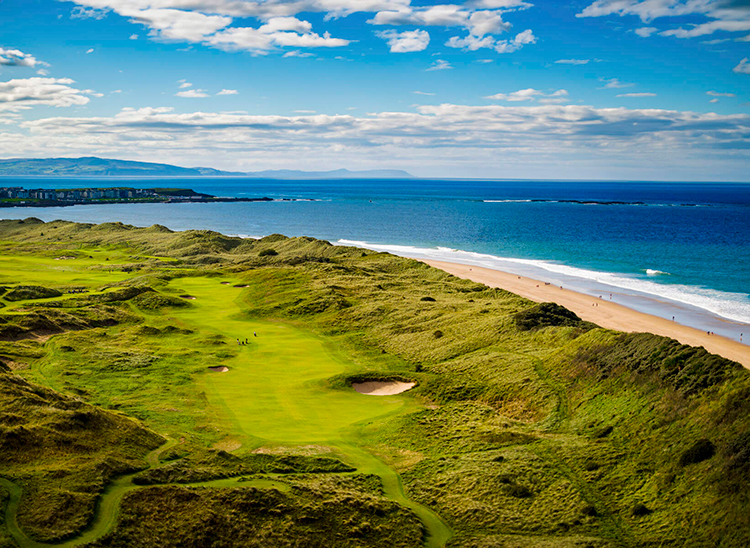
I don’t often list tee boxes among a golf course’s aesthetic attributes, but several launch parapets here deserve mention. Jutting out above the Atlantic, the tee boxes on the fifth and sixth holes are exactly where you’d stand sentry should Yara Greyjoy lead her fleet from the Iron Islands to the North of Ireland (for those who follow along the “Game of Thrones” television series.)
I could write much more about Ardglass, but there are more giddy layouts to share from Portstewart, Royal Portrush, and, lest we forget, that other County Down track, the Royal one that many consider the most beautiful golf course in the World.
A simple sign points to Royal County Down behind the Slieve Donard, a grand hotel facing the Irish Sea that’s also steps away from the resort town of Newcastle. Following the sign’s arrow to RCD feels like taking a non-descript trail from a Washington Road strip mall parking lot to Augusta National. Et voila, Eden!
The golf course itself is equally pristine. Unlike Augusta, carved and mounded from a former nursery, the RCD landscape required little more than formal holes and flags, as evidenced by tales of villagers playing among the rabbit warren before Belfast bankers took over in 1889 and formalized a 9-hole course. Though additional holes and many iterations were to follow, altering so much as a gorse branch today is considered sacrilegious.
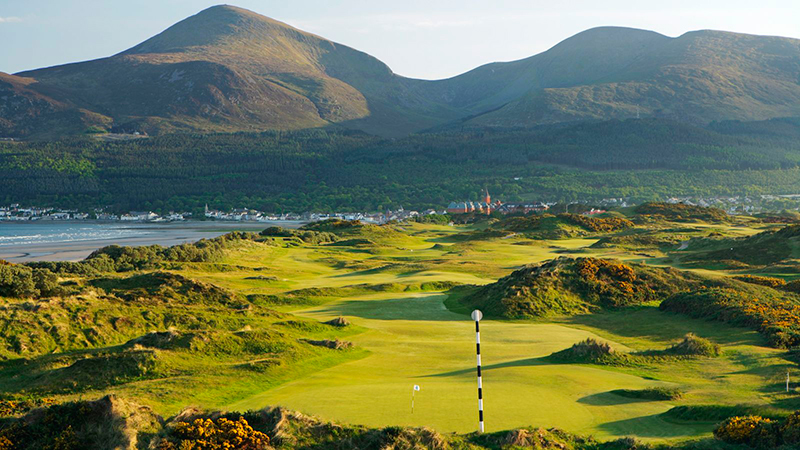
Northern Ireland
The opening 539-yard Par 5 provides the first of countless “pinch me” moments, a ribbon fairway skirting the shore, narrowing like a tightly purled corset with pot bunkers ready to cook your round from the get-go. Unlike Ardglass, you do have to wait until #2, a 444-yard Par 4, to launch your blind first tee shot.
Trusting that a fairway exists somewhere in the distance is a recurring theme in links golf, especially in links golf, especially on Irish links where dune topography results in significant elevation changes. It adds all sorts of mystery for the player, not least finding one’s golf ball should the drive get blown off course and miss the fairway.
The Par 4 446-yard 13th adds a rare severe dogleg into the mix (oh, and best to know your iron distances – green wears a gorse collar.)
Unlike traditional links, where the front nine travels out and the back nine returns, RDC’s first nine turns at the modest clubhouse. Sticklers will also find the triangular-shaped pond in the 17th fairway rather incongruous. I doubt either aberration will make it into retellings about playing what Golf Digest has ranked the #1 Golf Course in the World since it started rating such things 10 years ago.
Elevation may prove testy for locating errant drives and respiratory function, but it also allows for truly spectacular holes like “Devil’s Hill” on The Strand at Portstewart Golf Club. The 336-yard par-4 second hole requires you to split five-story hillocks before landing your ball on an uphill fairway.
The Strand, opened in 1908, is relatively young but hardly devoid of history. The green on no. 3, “The Settlement,” was home to early settlers some 9,000 years ago. “Rifle Range,” aka no. 5, was exactly that, a World War II firing range.
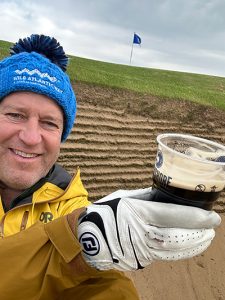
My favorite hole remains no. 9, “Larkhill,” not because the name recalls “To a Skylark,” an ode concocted by not one but two favorite poets, Wordsworth and Shelley. Rather it’s because the attendant at the halfway hut draughts a proper two-part Guinness pour, a pint so silky I settled into a pothole bunker to savor.
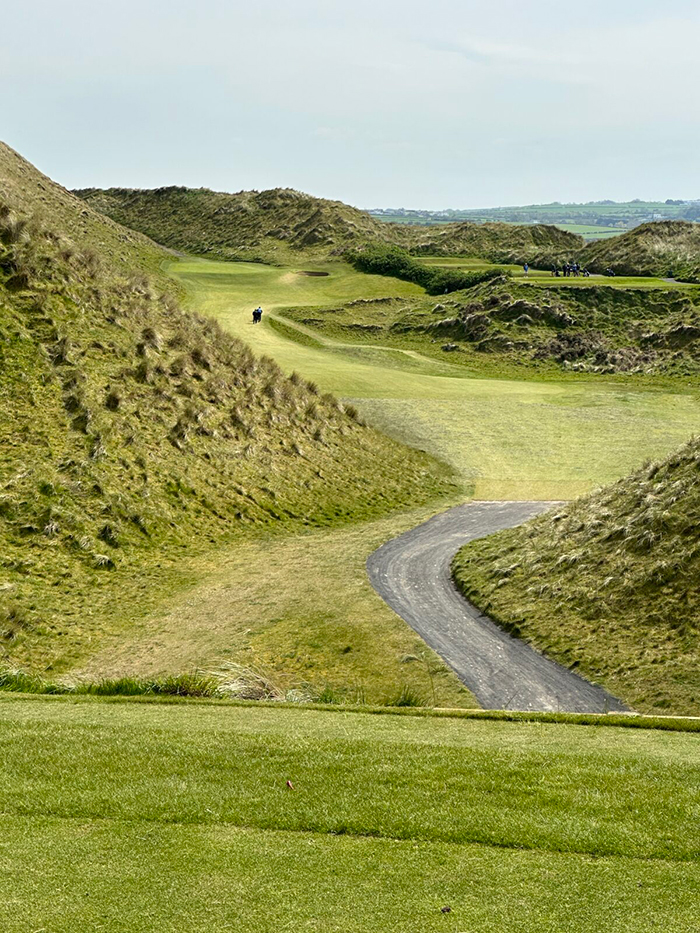
No.2
(That it took this long to mention “Guinness” is almost as sacrilegious as writing about Irish links golf and not yet mentioning the mesmerizing greens that require, to bastardize Shelley, “Thy skill to [putt] …thou scorner of the ground!”)
Irish links require blind shots, improbable bunker escapes, and an occasional thorn-hindered errant ball retrieval, but the greens make us declare “yes, yes, yes.” Take Giant’s Grave, the long par-5 second at Royal Portrush Golf Club.
To the joy of every golfer, Portrush returned to The Open Championship rota in 2019 when Irishman Shane Lowry won with poetic flourish. Scottie Sheffler hoisted the Claret Jug here in 2025. (The 2027 Ryder Cup will be contested in County Limerick at Adare Manor.)
Like the best links greens, little on Portrush’s putting surfaces change in undulation from the fairway, the apron and the adjacent waste areas. In other words, those mounds, grooves, and turtle backs scamper right on through the short grass.
And there’s the short par4, “White Rocks,” among the most spectacular holes on the planet. Should you land on the front of the green with a back pin placement, you’ll have a blind (a blind!) putt to the back tier. However, given the green falls off the sea cliff like a drop edge pool, better to be blind than drowned.
Naturally, one can’t speak of the abyss without mentioning “Calamity Corner,” the 236-yard par-3 16th, where a misfire to the right side is best summarized by W. B. Yeats: “He that made this knows all the cost, for he gave all his heart and lost.”
Golfing upon the great links courses of Ireland remains a lyrical experience, putting strokes strummed upon rippling greens, pitches plucked from impossible lies and drives blind as Joyce’s “Citizen” in the Cyclops Episode of Ulysses.
Seamus Heaney, Northern Ireland’s most recent Nobel laureate, best captures the sublime joy of playing Irish links: “And that moment when the bird sings very close/To the music of what happens.”
Follow Crai’s golf and other adventures on Instagram @travelcrais